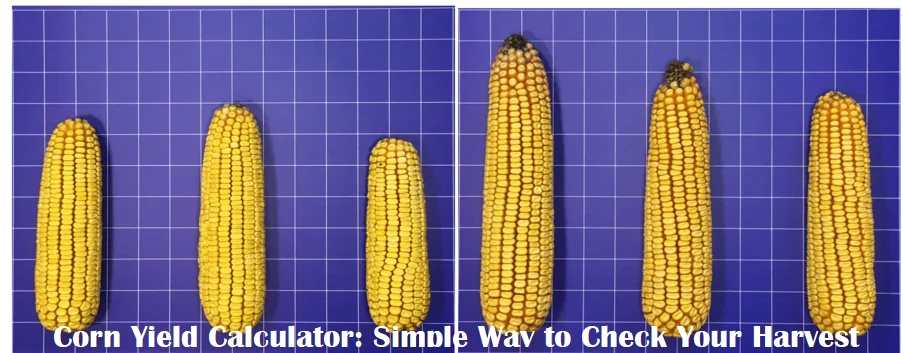
Every farmer wants to know how much corn their field will grow. It can be stressful to wait till harvest. It’s far preferable to have an idea early on. This is why a corn yield calculator is so useful.
- What Is a Corn Yield Calculator?
- Why is it important?
- How does a corn yield calculator work?
- Step 1: Take a Measurement of a Small Part of the Field
- Step 2: Count the Kernels on the Ear
- Step 3: Put the formula into action
- An Example in Simple Terms
- What is a bushel?
- How much corn do you get on average?
- What This Tool Can Do for You
- Common Problems That Affect Yield
- How to Get Better Results
- Farming and New Technology
- When Should You Calculate Yield?
- Who should use a corn yield calculator?
- Conclusion
- FAQs
Farmers can use a corn yield calculator to figure out how many bushels of corn they would be able to pick. It counts things in a small portion of the field. This helps farmers figure out how to save, sell and spend their money. In this post, you’ll understand in very simple terms how it works and why it’s vital.
What Is a Corn Yield Calculator?
It’s easy to use a corn yield calculator. It tells you how much corn your field can grow.
You only measure a tiny region instead of the complete field. Then you use numbers like this:
- How many plants are growing
- How many ears does each plant have
- How many kernels are on each ear
- The size of the seeds
Then, the calculator informs you:
- Bushels per acre
- Total bushels from your whole field
This makes farming easier and more intelligent.
Why is it important?
It might help you avoid a lot of difficulties if you know your corn output early.
1. Helps You Plan Your Money
You can guess how much money you can make if you know how much corn you can pick.
2. Helps with storing
Corn requires room. You can get your grain bins ready if you know how big your harvest will be.
3. Helps with sales
Prices of corn go up and down. You can choose when to sell if you know how much you expect to yield.
4. Aids in Problem Finding
You might search for problems like bad soil, not enough water or pests if the yield seems low.
Before it’s too late a corn yield calculator can give you vital information.
How does a corn yield calculator work?
It’s easy and focused on counting.
Step 1: Take a Measurement of a Small Part of the Field
First, measure 1/1000th of an acre. The row length depends on your row spacing.
For example:
- 30-inch rows = 17.4 feet
- 36-inch rows = 14.5 feet
- 20-inch rows = 26.1 feet
In that tiny region, count how many plants have decent hearing.
Step 2: Count the Kernels on the Ear
Then, choose some ears from different sections of the field.
- Count how many rows go around each ear.
- Count how many kernels are in a row.
- Do the math on both numbers.
Example:
20 rows × 28 kernels = 560 kernels on one ear
Do this for a few ears and then get the average.
Step 3: Put the formula into action
Now you can apply this easy formula:
(Plants in 1/1000 acre × Average kernels per ear) ÷ 90
We use the number 90 since that is the normal amount of kernels in a bushel.
- If the kernels are huge, divide by 85.
- If the kernels are little, divide by 105.
This tells you how many bushels per acre you have.
A corn yield calculator solves this arithmetic for you in a flash.
An Example in Simple Terms
Let’s say:
- You counted 33 plants
- Each ear has about 560 kernels
Now calculate:
33 × 560 = 18,480
18,480 ÷ 90 = 205.3
So, your land might yield around 205 bushels per acre.
If you have 50 acres:
205 × 50 = 10,250 bushels total
It’s quick and straightforward with the corn yield calculator.
What is a bushel?
A bushel is a unit of measurement for corn.
- 1 bushel of corn weighs 56 pounds (about 25 kg).
An average ear of corn weighs about half a pound. So about 112 ears make one bushel.
Kernel size matters because bigger kernels mean fewer kernels per bushel.
There are three common sizes:
- Small kernels
- Medium kernels
- Large kernels
A decent corn yield calculator lets you Choose the size of the kernels.
How much corn do you get on average?
The average maize yield in the world is roughly 85 bushels per acre.
Farmers in some nations, like the United States, may cultivate more than 170 or even 200 bushels of corn per acre.
Yields are growing every year because of:
- Better seeds
- Better machines
- Better fertilizers
- Modern farming methods
Farmers can use a corn yield calculator to see how their field stacks up against these averages.
What This Tool Can Do for You
1. Saves time
You don’t have to complete extensive calculations by hand.
2. Lessens Errors
The calculator makes it less likely that you will make math mistakes.
3. Simple to Use
It’s easy for even new farmers to utilize.
4. Helps You Make Better Choices
You can make better plans when you know your numbers.
Common Problems That Affect Yield
The yield may not be what you thought it would be. Here are some reasons why:
Bad Growth of Plants
When seeds don’t grow well, there are fewer plants.
Bad Weather
Corn can be hurt by too much rain, drought, or heat.
Diseases and Pests
Ears can be hurt by fungi and bugs.
Not getting enough nutrients
To grow strong, corn needs nutrients like nitrogen.
If your estimate is low, you can find these difficulties early.
How to Get Better Results
To get a decent idea:
- Check different parts of the field
- Do not count damaged ears
- Count carefully
- Calculate near dent stage when kernels are fully formed
Counting well produces greater outcomes.
Farming and New Technology
Farming is better now than it used to be.
Some farmers use:
- Mobile apps
- Online tools
- GPS machines
- Satellite images
Still, a simple corn yield calculator based on field counting is one of the most trusted methods.
It is simple, quick, and reliable.
When Should You Calculate Yield?
The optimal moment is just before the dent stage. At this point:
- Kernels are almost fully grown
- You can see which kernels will mature
- Your estimate will be more accurate
Don’t do the math too soon because the kernels could not be fully formed.
Who should use a corn yield calculator?
This tool is helpful for:
- Small farmers
- Large farm owners
- Students learning agriculture
- Crop advisors
- Farm managers
Anyone who grows corn can use a corn yield calculator to learn more about their crop.
Conclusion
It takes a lot of work to grow maize. But it doesn’t have to be hard to anticipate your harvest.You can get an idea of what your total crop will be like by counting the plants and kernels in a tiny portion of your field.
Every year, farming gets smarter. Farmers may make better decisions and feel better about their harvests with simple tools like a corn yield calculator.
FAQs
Q1. When is the optimum time to utilize a calculator for corn yields?
The optimal time to utilize a corn yield calculator is while the corn is denting. At this point, the kernels are virtually fully formed, thus the estimate will be more accurate.
Q2. How can I count kernels to get better results?
Count the rows on the ear, and then count how many kernels are in one row. Do the math on both numbers. Do this for a few years and then determine the average to get a better idea.
Q3. What does the size of the kernel have to do with yield calculation?
The size of the kernel determines how many kernels are in one bushel. If the kernels are bigger, there are fewer of them in a bushel. If the kernels are smaller, there are more of them in a bushel.
Q4. Is it easy for beginners to utilize a corn yield calculator?
Yes, it’s easy for beginners to utilize a corn yield calculator. It only needs simple counting and basic information from the field, and a lot of online applications handle the math for

Alex Morgan is a home improvement enthusiast from the U.S. who loves simplifying complex calculations for builders and DIYers. At TogCalculator.com, Alex shares easy-to-use guides and accurate calculator tools that help homeowners plan smarter projects. His goal is to make construction math simple, reliable, and stress-free for everyone.