How Long Does Alcohol Stay In Your Blood Based on BAC Level
How long does alcohol stay in your blood according to science? Most people who drink occasionally search for answers to such questions. A single drink is normally taken as harmless, and people who drink occasionally have no idea about its effect and reaction on the body. There are many facts related to alcohol about which people are not aware.
- Alcohol disappears quickly, but it stays in the blood for a long time
- The body processes the alcohol at a limited speed
- Alcohol enters the bloodstream within minutes and starts reacting
- Blood Alcohol Concentration BAC does not drop immediately; it takes hours
- The liver breaks down the alcohol content at a very slow pace.
- One glass can affect your body, and the alcohol can stay in your blood for many hours
- Its influence on the body and mind starts as soon as a person consumes it
- A BAC calculator only gives an estimate based on body weight and alcohol quantity.
These are some of the facts that every person who consumes alcohol should know. Now let’s move to the main topic to know the time of alcohol staying in the blood according to science and the BAC level.
How Long Does Alcohol Stay in the Blood?
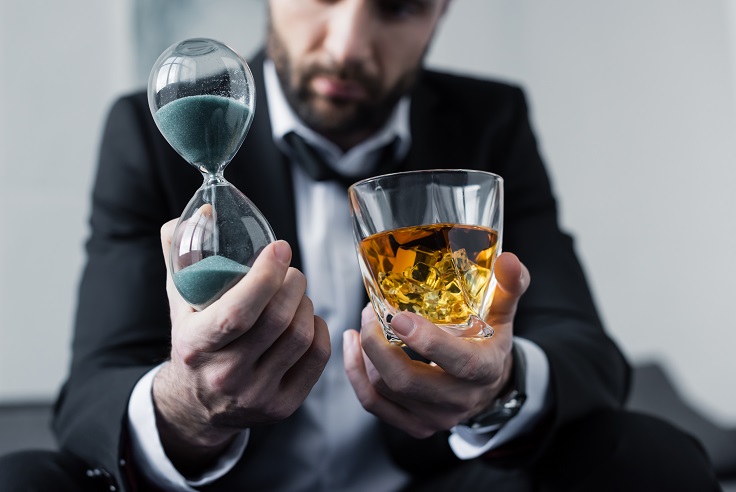
The time alcohol stays in the blood is based on the body’s ability to process it. If your liver processes it fast and you have a good metabolic rate, the alcohol will stay in your body for a short time.
If your liver function is slow, then it will take time to break down the alcohol content. It will lead to a longer stay of alcohol in the body and pass in the blood.
A healthy liver breaks down the alcohol at the rate of 0.015 % per hour. This is a normal rate of alcohol breakdown and shows that alcohol does not leave the body immediately and stays in for long hours.
Example
If a healthy person with a healthy body and a weight of 60 kgs drinks two standard drinks.
Here, we can take a standard drink of 12 oz beer at 5% alcohol by volume (ABV) as an example.
Now, when he takes two 12-oz drinks, a total of 24 oz, the total alcohol by volume that will enter his body will be 10%.
The volume of beer is 12 oz, which is 355 ml.
ABV in 12 oz = 5% = 0.05
To know the volume of pure alcohol in one drink:
355 ml × 0.05 = 17.75 ml of pure alcohol
1 ml of alcohol weighs = 0.789 grams, we convert to grams
17.75 ml × 0.789 = 14 grams of pure alcohol
So, one 12-oz beer at 5% ABV contributes 14 grams of alcohol.
If you had two beers, that’s 28 grams of alcohol total that enters the body of the person.
10% ABV beer would be 28 grams of alcohol per 24 oz.
ABV & BAC
ABV is also written on the bottles of the drink. This ABV represents the presence of alcohol content in that drink, not the total BAC in your blood. The BAC is calculated based on body weight, gender, and the amount of alcohol consumed.
When a 60 kg person drinks one 12 oz beer, 14 grams of pure alcohol enter the blood. If the same person drinks a second 12-oz beer within an hour, another 14 grams of alcohol enter the blood.
The first drink will raise their blood alcohol concentration to 0.02 – 0.03 percent. This can be calculated on a BAC calculator. The second drink will raise the BAC to around 0.05%. This can be below or above this.
This amount will take a maximum of 3 hours to dissolve at a normal speed of 0.015% BAC per hour. This means the 35 ml of alcohol will stay in the blood for 3 hours.
This is the alcohol staying speed in the body of a healthy person. However, some factors can affect this speed. These factors are:
- Metabolism rate
- Liver health
- A person’s gender, age, and physical condition
- The body weight
What Does Science Say About the Removal Time of Alcohol From the Body?
Medical research by different institutes, including the National Institute on Alcohol Abuse and Alcoholism (NIAAA), shows that the human body removes alcohol at a fixed and limited rate.
The liver is a vital organ that is connected with this process. It processes most of the alcohol using enzymes. This process does not speed up or slow down with any medication or any food intake, like most people think coffee can do. Neither water, nor sleep, nor exercise can bring any change.
Some studies also highlighted that, on average, the body lowers blood alcohol concentration by about 0.015% per hour. This rate stays mostly the same for a person, regardless of how drunk they feel. A higher BAC only means it takes more time to return to zero.
Scientific studies claim that alcohol enters the bloodstream quickly. Peak blood alcohol level mostly starts to appear within half an hour and stays for 2 hours after drinking. After this point, the decline begins. The decline happens slowly and steadily.
Researchers have confirmed that time is the only factor that plays a role in removing alcohol from the blood. On the other hand, it also confirms that the body’s weight, sex, genetics, and liver health can cause small variations, but no method can bypass the natural processing speed.
This scientific understanding helps explain why alcohol can stay in a person’s blood for many hours after the last drink and why legal and safety risks continue until BAC reaches zero.
How Long Does Alcohol Stay in the Blood Based on BAC?
The body lowers blood alcohol concentration at an average rate of 0.015% BAC per hour. This rate remains fairly constant for most people. A higher BAC only means the body needs more time to return to zero.
- BAC 0.02 – 0.03% – Alcohol at this level may stay in the blood for about 1–2 hours.
- BAC 0.04 – 0.05% – Alcohol at this level usually takes 2–3 hours to clear completely.
- BAC 0.06–0.07% – The body may need 4–5 hours to process this amount of alcohol.
- BAC 0.08% – This level can take 5–6 hours or more to return to zero.
- BAC 0.10% and above – Alcohol may remain in the blood for 7–10 hours or longer, depending on the starting level.
These time estimates assume a normal alcohol elimination speed. Understanding how long alcohol stays in the blood helps people stay safer.
Case Study – CDC Findings on Alcohol in the Blood
A case study was conducted by the Centers for Disease Control and Prevention (CDC) to explain the staying time of alcohol in the blood based on blood alcohol concentration levels and metabolism speed.
The research found that alcohol enters the blood quickly after consumption and spreads through body tissues within minutes. The liver then begins breaking it down at a consistent rate.
CDC data shows that the average adult body lowers BAC level in the blood by 0.015% per hour. This rate remains the same regardless of the amount consumed.
When a person drinks more alcohol than the liver can process, BAC continues to rise. Once drinking stops, BAC begins to fall slowly as the liver clears alcohol from the blood.
The CDC also highlights that a person with a BAC of 0.08% can still have some traces of alcohol in their blood for six hours or longer. During this time, the human body remains intoxicated by the influence of alcohol.
This case study supports the scientific conclusion that time is the only factor that reduces alcohol levels in the blood. It is necessary to understand the risks of alcohol influence
Final Words
How long does alcohol stay in blood? This is important to know for analyzing realistic expectations. The alcohol stays in the blood based on the liver processing it. It does not get washed away from the body immediately, it takes hours and sometimes a day to fully vanish off from the drinker’s blood. The pace of alcohol removal is slow and steady for a healthy person.
The liver is the only vital organ that plays a role in breaking down the alcohol content and mixing it with the blood. A small amount of alcohol intake can also stay in the blood for long hours. The higher the BAC is, the more time it will take to get removed from the blood. Feeling sober does not mean that alcohol has been removed from the body. It is present for hours and can have an influence too, based on its level.
If you want to know your BAC level, there are several friendly tools that can help you analyze your Blood Alcohol Concentration based on your bodily factors. So, use Tog Calculator’s BAC calculator to find out the estimated alcohol content level in your blood and take steps accordingly.
FAQs
How long does alcohol stay in the blood?
Alcohol stays in the blood for many hours and sometimes for a complete day. It can be from six hours to 24 hours. This is tied to the quantity the person intakes.
Can drinking water remove the alcohol from the blood?
No, drinking water cannot remove the alcohol from the blood. It has no effect on the alcohol level in your body and is just for hydration.
How long does a single standard drink stay in the blood?
One standard drink can stay in the blood for 3 hours. Sometimes, this can depend on body weight and metabolism.
How long does alcohol stay in the blood if the BAC is 0.08%?
A BAC of 0.08% can stay in the blood for more than six hours. It will continue declining, and after six to seven hours, the BAC will return to zero.
Does sleep help alcohol leave the blood faster?
Sleep does not increase the speed of alcohol elimination. The liver works at the same rate during sleep.

Alex Morgan is a home improvement enthusiast from the U.S. who loves simplifying complex calculations for builders and DIYers. At TogCalculator.com, Alex shares easy-to-use guides and accurate calculator tools that help homeowners plan smarter projects. His goal is to make construction math simple, reliable, and stress-free for everyone.